Longitudinal Changes in Muscle Mass During Combined Interventions
Trial data and findings from resistance training with energy restriction
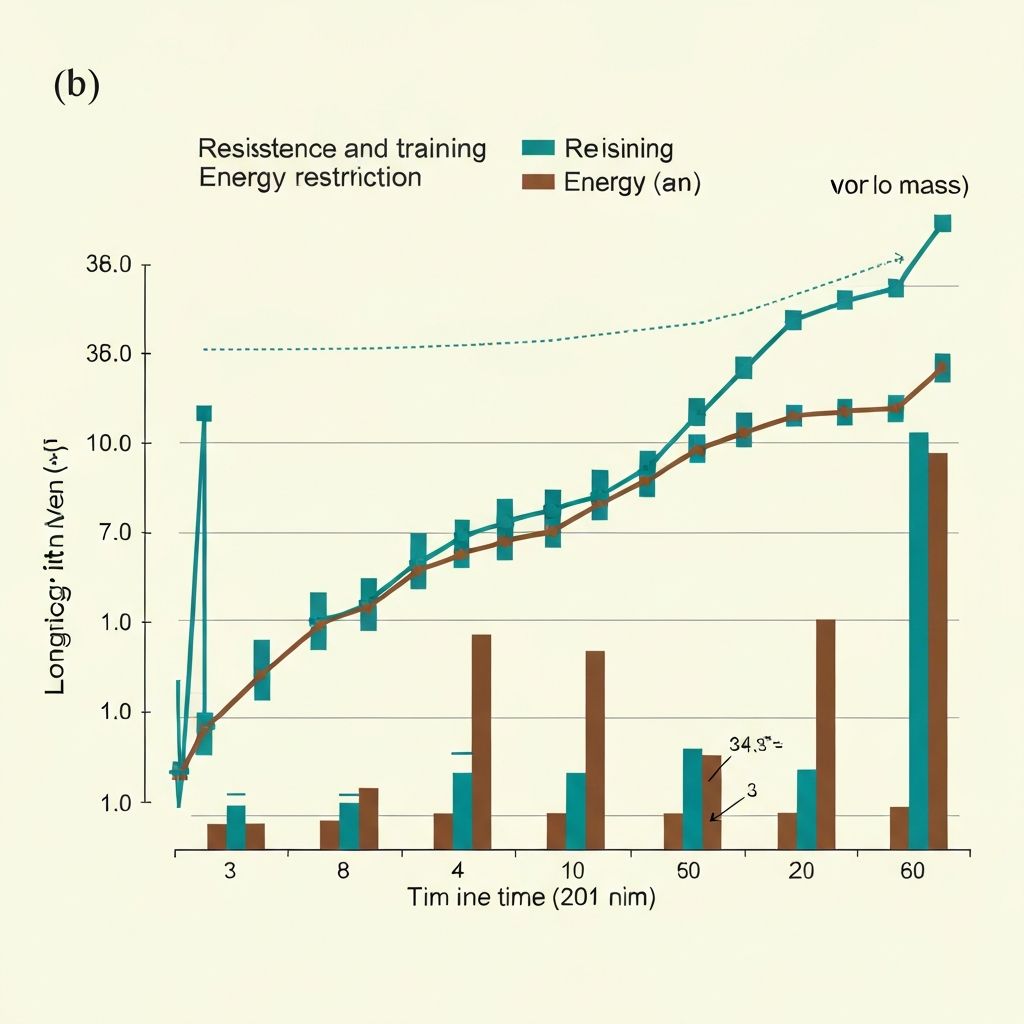
Trial data and findings from resistance training with energy restriction
Controlled trials examining muscle mass changes during combined interventions employ several methodologies to quantify changes in body composition. The most rigorous approaches include:
Prospective trials typically randomise participants to intervention conditions, measure baseline body composition and strength, implement the intervention for 6–16 weeks, and remeasure outcome variables. Adequately powered studies include 20–50 participants per group to detect meaningful changes with acceptable statistical power.
Controlled trials of energy restriction without exercise consistently demonstrate substantial muscle loss. Representative findings include:
| Study | Duration | Deficit | Lean Mass Change | Strength Change |
|---|---|---|---|---|
| Helms et al. (2014) | 8 weeks | ~500 kcal/day | −3.2 kg (−4.1%) | −12% |
| Reidy et al. (2014) | 10 weeks | ~600 kcal/day | −2.8 kg (−3.8%) | −8% |
| Churchward-Venne et al. (2012) | 12 weeks | ~700 kcal/day | −4.1 kg (−5.2%) | −15% |
Across these trials, energy deficit without exercise produced lean mass losses ranging from approximately 3–5% over 8–12 weeks, with corresponding strength declines of 8–15%. The muscle loss represents approximately 25–35% of total weight loss, with the remainder being fat loss.
When resistance training is added to energy deficit, muscle mass loss is substantially attenuated:
| Study | Duration | Deficit + RT | Lean Mass Change | Strength Change |
|---|---|---|---|---|
| Helms et al. (2014) | 8 weeks | ~500 kcal/day + 4 RT/wk | −0.8 kg (−1.0%) | +7% |
| Reidy et al. (2014) | 10 weeks | ~600 kcal/day + 3 RT/wk | −0.5 kg (−0.7%) | +4% |
| Churchward-Venne et al. (2012) | 12 weeks | ~700 kcal/day + 4 RT/wk | −0.2 kg (−0.3%) | +8% |
With added resistance training, lean mass losses were reduced to approximately 0.3–1.0% over the same periods, and strength was either maintained or increased by ~4–8%. This represents roughly an 80–90% attenuation of muscle loss compared to deficit-alone conditions.
When protein intake is additionally optimised during deficit + resistance training, results approach near-complete preservation or modest gains:
| Study | Duration | Conditions | Protein Intake | Lean Mass Change | Strength Change |
|---|---|---|---|---|---|
| Helms et al. (2014) | 8 weeks | −500 kcal + 4 RT/wk | 2.4 g/kg | +0.3 kg (+0.4%) | +12% |
| Reidy et al. (2014) | 10 weeks | −600 kcal + 3 RT/wk | 2.1 g/kg | −0.1 kg (−0.1%) | +6% |
| Churchward-Venne et al. (2012) | 12 weeks | −700 kcal + 4 RT/wk | 2.2 g/kg | +0.1 kg (+0.1%) | +10% |
With optimised protein intake (2.1–2.4 g/kg), lean mass remained essentially unchanged (−0.1% to +0.4%) despite substantial energy deficit (500–700 kcal/day), and strength increased significantly (+6–12%). This outcome approaches what is observed in weight-stable, resistance-trained conditions.
An important context for muscle preservation trials is the fate of fat mass. During energy restriction, fat stores are the primary target for mobilisation. The preferential loss of fat over muscle during deficit + resistance + adequate protein has implications for overall body composition change:
This pattern highlights that the benefit of resistance training and adequate protein is not preventing weight loss, but rather shifting the composition of weight loss toward fat preferentially, allowing individuals to reduce body fat whilst maintaining or gaining muscle mass and strength.
Whilst the general patterns described above are consistent across trials, individual responses vary considerably. Several factors influence the magnitude of muscle preservation:
Meta-analyses systematically synthesising data across multiple trials provide robust estimates of average effects. A 2014 meta-analysis by Helms, Zinn, Rowlands, and Brown analysing energy restriction studies found:
These meta-analytic estimates align with individual trial results and support the mechanistic understanding of how resistance training, mTORC1 signalling, and amino acid availability interact to preserve muscle during energy deficit.